Environment, Climate Resilience, and Fredericton’s Role
As always, my approach is practical: focus on municipal responsibilities, respect staff expertise, measure outcomes, and make decisions that strengthen resilience, affordability, and quality of life.


In the final days of the campaign, I’ve received several questions about environmental policy, climate resilience, natural areas, infrastructure, data centers, and the proposed Sisson Mine.
These are fair questions. They also deserve honest answers about what Fredericton City Council can and cannot do. Many environmental policy levers sit primarily with the federal and provincial governments. That includes electricity generation, provincial building codes, vehicle standards, industrial regulation, mining approvals, environmental assessment, and broader climate policy.
But municipalities absolutely have a role to play.
Cities make important decisions about land use, stormwater management, transportation, municipal buildings, parks, trees, natural assets, infrastructure renewal, and emergency preparedness. Those decisions affect flooding, heat, emissions, water quality, biodiversity, affordability, and quality of life.
My approach is straightforward: focus on the tools a municipality actually has, use them well, respect staff expertise, measure outcomes, and make decisions that strengthen Fredericton’s resilience and affordability over the long term.
Start with the work already underway
If elected, my first priority would be to request a comprehensive update from staff on the City’s environmental and climate-related work: what is working well, what is off track, what needs more support, what requires adjustment, and what may no longer be the best use of resources.
Since launching my campaign about fifteen months ago, I have attended many Environmental Stewardship Committee meetings. As a member of the public, I could listen and learn, but not ask the kinds of detailed follow-up questions councilors can ask. I would want to use that opportunity constructively.
Council sets direction, but staff brings the technical expertise. Fredericton has a strong environmental team, and Council’s role should be disciplined: set clear goals, ask good questions, make responsible budget decisions, and measure progress.
Recent presentations to the committee show that Fredericton already has substantial work underway.
The City’s Resilience Lands Management Framework identifies more than 285 hectares of City-owned floodplains, wetlands, and river corridors that are intentionally protected through EOS zoning and are not suitable for development. These lands reduce flood risk, store carbon, support biodiversity, stabilize shorelines, improve urban cooling, and reduce future pressure on grey infrastructure and post-flood recovery costs. The next step is to move from acquisition and protection toward site-specific management, public communication, partnerships, and policy tools where appropriate.
The City’s February 2026 Climate Action Progress Update also shows both progress and challenges. Community emissions are down 7% from the 2000 baseline, and per capita emissions are down 43%, but overall emissions remain off track for the 2030 objective, particularly because transportation and waste emissions are increasing.
The same update notes that Fredericton has started, is implementing, or has completed 89% of Phase 0 and 1 actions in the Community Energy and Emissions Plan, 84% in the Corporate Energy and Emissions Plan, and 93% in the Climate Change Adaptation Plan. That tells me two things:
This is not an area where the next Council needs to start from scratch.
Council does need to keep asking whether the actions underway are producing the outcomes residents need.
Climate resilience is not abstract
On climate preparedness, I bring both a policy interest and lived experience.
Before moving to Ward 10, I lived in Ward 11 and experienced back-to-back flooding in 2018 and 2019. That made it very clear how climate resilience shows up at the household level. As homeowners, we had to step up our planning and mitigation efforts.
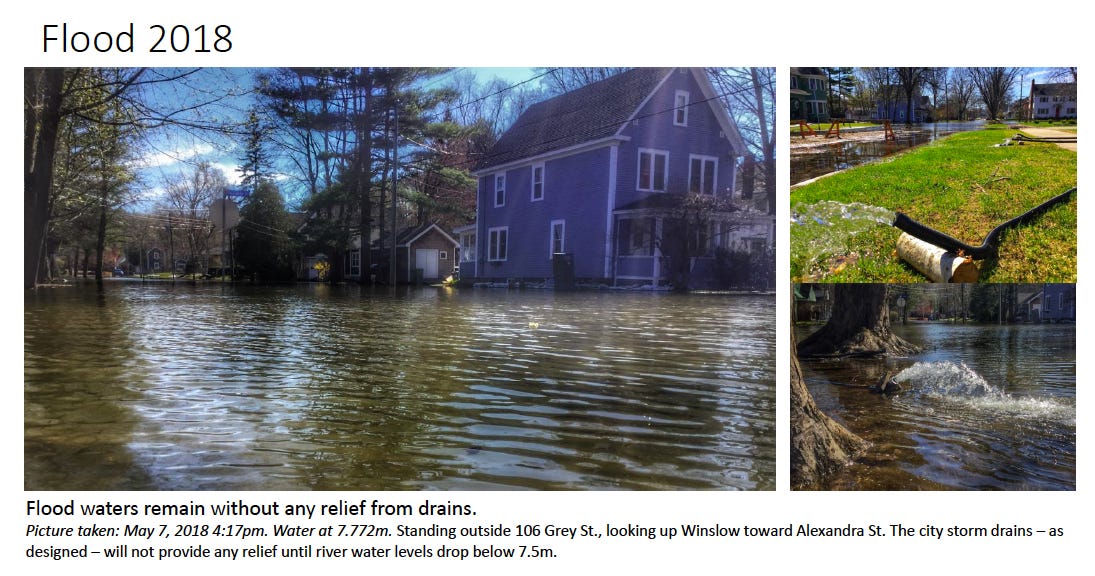
At the same time, I advocated for improved City infrastructure, including duckbill valves on stormwater drains along the river to reduce backflow during floods.
That experience shaped my view.
Climate resilience is not abstract. It is about whether a homeowner can protect their property. It is about whether streets and stormwater systems can handle more intense events. It is about whether floodplains are protected from inappropriate development. It is about whether the City is making practical investments before disaster strikes.
Household preparedness matters. So does municipal infrastructure.
Fredericton will need both grey infrastructure and green infrastructure. Pipes, culverts, roads, storm drains, lift stations, and engineered flood mitigation matter. So do wetlands, trees, floodplains, rain gardens, permeable surfaces, and natural areas that absorb water and reduce risk.
Not far from our current home, work continues on the Northumberland Street Infrastructure Renewal (Phase 3), which provides significant upgrades to stormwater capacity.
The right approach is not ideology. It is evidence, lifecycle costing, site conditions, and risk management.
Natural areas and water protection
I support the responsible use of municipal planning tools to protect ecologically valuable lands, especially when such protection also reduces long-term public costs. That includes continued attention to stormwater management, watershed protection, wetland protection, floodplain planning, and infrastructure decisions that protect the Wolastoq/Saint John River and local watercourses.
I would also be open to hearing from organizations such as the Conservation Council of New Brunswick and other local experts, while ensuring decisions are grounded in local data, municipal authority, and budget realities.
The City’s Green Building Guidelines, updated in June 2025, point to low-impact stormwater techniques such as green roofs, permeable surfaces, rain gardens, bioretention, and silva cells. Those are exactly the kinds of tools that should be considered where they make practical and financial sense.
Energy costs and municipal buildings
On energy costs and municipal emissions, I support continued investment in practical projects that reduce long-term operating costs.
The City’s Green Building Guidelines apply to City-owned buildings and future City-funded facilities. Their purpose is to move City facilities toward net-zero emissions operations by 2050 through energy efficiency, better design, water conservation, waste reduction, lower-carbon materials, and renewable energy where feasible.
I am particularly interested in projects where the financial case and environmental case line up. For example, the Regent Street Depot solar project is expected to power 100% of the depot’s electricity and EV-charging needs, with an estimated electricity cost avoidance of about $10,800 in 2026 and a simple payback period of less than 10 years.
That is the kind of environmental action residents can understand: lower emissions, lower operating costs, and better long-term stewardship of public assets. What’s not to like?
Transportation
Transportation emissions are one of Fredericton’s biggest climate challenges, and I support continued implementation of the Integrated Mobility Plan, active transportation connections, better transit service, safer walking and cycling routes, and practical EV infrastructure where it makes sense. It is arguably one of the most connected plans I’ve seen across various departments at City Hall. Kudos to the staff and the current council for bringing this forward.
This is also about affordability and quality of life. Not every resident can or wants to rely on a personal vehicle for every trip. A better transportation network gives people more choice, and I look forward to the share of vehicle transport falling from 72% to 60% by 2050.
On school buses, I support the objective of reducing emissions from student transportation, but school transportation is not a municipal responsibility. As a resident and taxpayer, I would want to see further evidence on safety, reliability in New Brunswick conditions, charging infrastructure, maintenance capacity, cold-weather performance, lifecycle cost, and whether electric buses can meet the daily demands placed on the system. The goal may be worthwhile, but implementation has to be safe, reliable, and practical. I would also want to understand what, if any, tradeoffs are being made.
Pesticide and herbicide use
On pesticide and herbicide use, I would want to review current City practice, provincial rules, operational requirements, and enforcement tools before committing to a specific bylaw. Plotting a path forward requires a solid understanding of where we are today. In principle, I support reducing unnecessary pesticide and herbicide use, especially on public lands. But any policy needs to be practical, enforceable, and informed by staff expertise.
Data centres
I spent my career in the information technology industry, and I have questions about data centers. Let me be clear: I am not opposed to technology infrastructure in principle. Fredericton is a knowledge-based city with real strengths in technology, research and development, and entrepreneurship. We need to build on those strengths.
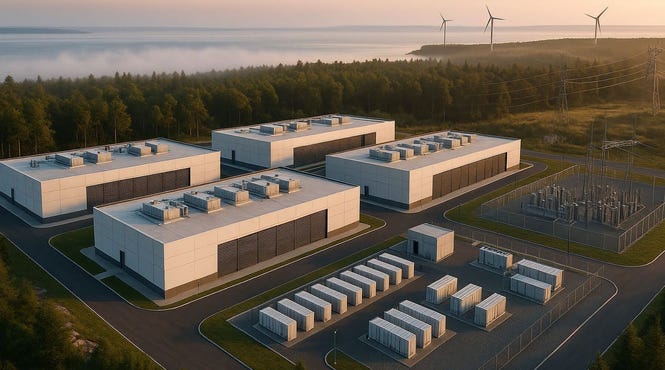
But I am skeptical of large-scale data center proposals where the promised economic impact may not justify the public costs, infrastructure demands, water use, electricity demand, land use, and long-term sustainability concerns.
Before supporting any major data center proposal, I would want to understand the full local value proposition. For example,
How many permanent jobs would be created? What kind of jobs?
What is the municipal tax benefit?
What water and electricity demand would be created?
Would infrastructure upgrades be required? Who pays for those upgrades?
Would the project crowd out other economic development opportunities with stronger long-term benefits?
If elected, I would like to see Ignite prepare or commission a clear economic impact analysis on data centers for the capital region. That work should not simply repeat industry claims; it should compare data centers against other possible uses of land, electricity capacity, water, infrastructure, and economic development efforts.
In my years as the chair of Ignite, formerly Enterprise Fredericton, I believe economic development should be measured by long-term community returns, not just capital investment headlines and ribbon-cutting ceremonies for today.
Sisson Mine
I have previously responded to a resident about the proposed Sisson Mine and met earlier this year with a resident who had studied the issue closely and raised many of the same concerns.
My position is that a project of this scale raises legitimate questions about watershed protection, long-term environmental risk, emergency services, infrastructure impacts, and potential municipal exposure.
The proposed mine is in the Nashwaak watershed, and concerns about water pollution, long-term damage, and downstream impacts are reasonable questions for residents to raise.
At the same time, jurisdiction matters. Mining approvals, environmental assessment, operating conditions, financial assurance, and enforcement are primarily provincial and federal responsibilities. Fredericton council cannot approve or reject the Sisson Mine. What it can do is ask the right municipal questions in public.
If elected, I would welcome additional information and discussion through committee or Council, particularly around impacts on watershed health, municipal infrastructure, emergency services, long-term fiscal exposure, and risks to downstream communities.
It has been years since I last received a report from the Regional Natural Resources Task Force, formed back in 2015 when Sission Mine was all the buzz. Fast-forward to now: Ignite’s Vision 2030 identifies natural resources as a priority sector. That makes it even more important to ask serious questions about risk, return, and long-term community impact.
The project requires significant taxpayer support to get started, and appears to require further government intervention to create an artificial price floor. We need to be very clear about who benefits, who pays, and who bears the risk. I am cautious about using public money to prop up a market unless there is a compelling public-interest case. I get the larger discussion on critical minerals in the geopolitical climate. That’s not a green light to dig, baby, dig. If the project poses unacceptable risks to the community or watershed, those concerns should be clearly and publicly communicated to the responsible provincial and federal authorities.
To be blunt, is the risk worth the return?
My approach
I do not think environmental policy at the municipal level should be performative. It should be practical, measurable, and connected to the real decisions the Council makes.
That means protecting floodplains where development should not happen.
It means investing in infrastructure before failure becomes more expensive.
It means reducing operating costs in City buildings.
It means making transportation safer and more flexible.
It means asking serious economic questions before accepting big promises.
It means listening to staff, residents, and outside experts.
And it means being honest about jurisdiction, costs, trade-offs, and results.
My commitment is to bring that same approach to Council: listen first, communicate clearly, and deliver measurable results.